What is a Mirrorless Camera, The difference with a DSLR?

When I hear the term “changing camera lens” (ILC) alias camera with a lens that can be changed, usually the pictured is a DSLR camera along with a row of large and heavy lenses.
But not all ILC can be classified as a Digital Single-Lens Reflex (DSLR). In recent years, ILC has circulated a new type of size that is much more compact. This camera category is commonly known as Mirrorless ILC (MILC) or for short “mirrorless” only.

What is a mirrorless camera? Appropriate nickname which means “without mirror”, the real mirrorless is a DSLR that removed the light reflector (mirrorbox).
Without a mirrorbox that serves to bend light from. Optical viewfinder, the size of the mirrorless camera can be remotely shrunken compared to DSLR, while retaining the captured image quality and replaceable lenses.
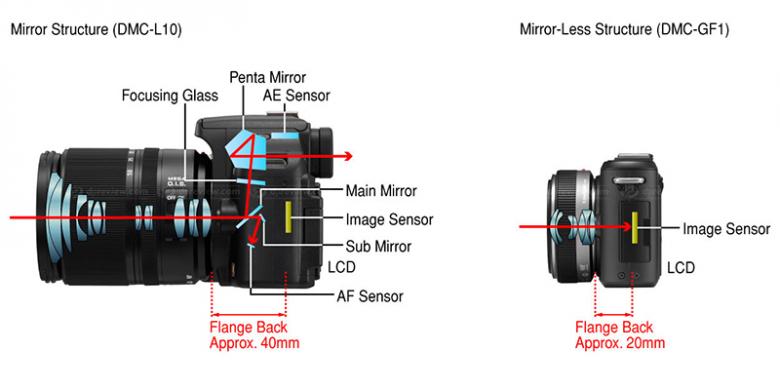
Panasonic’s output diagram of the difference between Lumix GF1’s mirrorless camera and the Lumix L10 DSLR. The DSLR mirrorbox mechanism is made up of the main mirrors that deflect light from the lens to the OVF and metering sensors (AE Sensors), and a second mirror (sub mirror) that bends light to the AF sensor at the bottom of the camera to autofocus. The contest, the mirrorless construction is much simpler as it is lightly forwarded directly to the image sensor, which then holds the captured image as a preview on the LCD or EVF screen.
Between the mirrorless and the DSLR
Because it does not have a mirrorbox, the mirrorless camera has the amount of difference with DSLR in addition to its relatively smaller form and simpler construction (without mechanical components for mirrors).
First, mirrorless does not have an optical viewfinder (OVF, optical viewfinder). Processor or electronic viewfinder (EVF, electronic viewfinder).
How EVF works is actually the same as the LCD screen, channeling the image through the sensor that continues to active. It’s just a different placement and size, already created the same optical viewfinder to “dikeker” with the eyes.
EVF has advantages over OVF, for example users can directly see changes in exposure results when adjusting parameters such as aperture, ISO, or white balance. Can also be added overlay of various useful information, such as level indicator or histogram for guided disclosure.
The drawback, EVF more extravagant power because the camera must always activate the sensor and screen viewfinder so that users can see the picture.
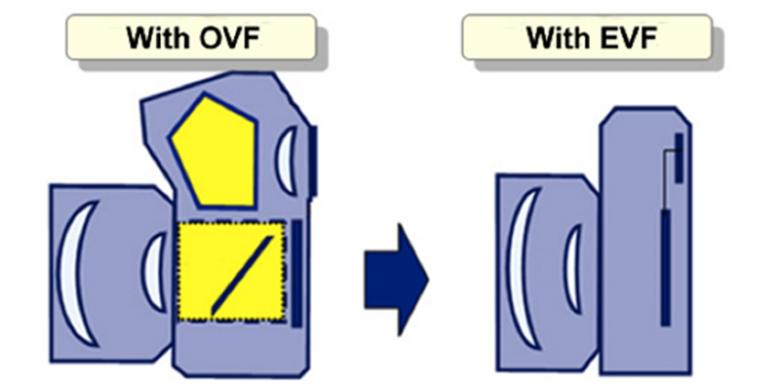
The OVF on the DSLR displays the image from the lens (via The Lens, TTL) by bending the light through the mirrorbox and pentaprisma mechanisms, as shown in the yellow drawing area in the left image. EVF on mirrorless has a way of working with the LCD screen, which shows the image captured by the sensor. Only, the laying and size is different.
DSLR users can see the object in front of the lens (Through The Lens, TTL) via OVF when the camera is not turned on. This is because the mechanism of the mirror from light to pentaprisma, then viewfinder, without having to the sensor.
Instead, the EVF on the mirror will look pitch black when the camera is not on. If the camera is on and the sensor is on, then the image “seen” by the lens can be displayed in EVF mirrorless.
When used to shoot through the LCD, both mirrorless and DSLR (via Live View) using the same working principle, while the image images are captured sensors to the screen.
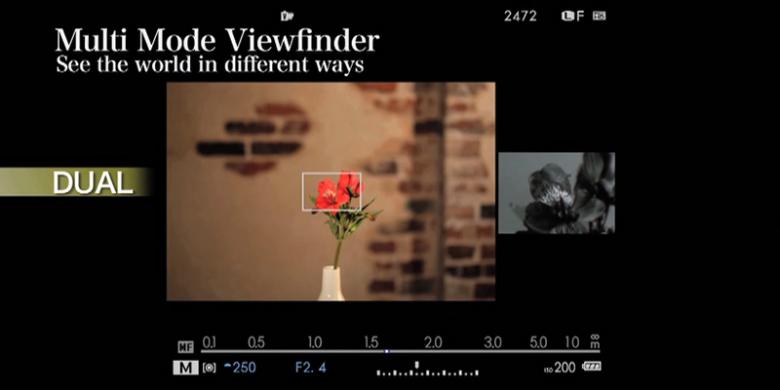
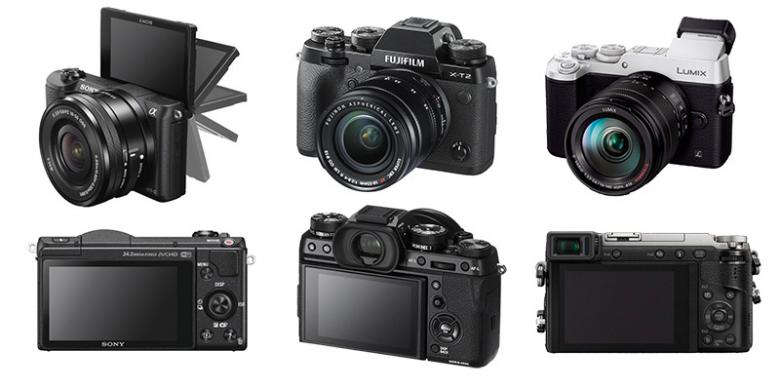
Because on a digital display, EVF’s mirrorless camera can be set to display a variety of things. Also included for the display and a smaller display for manual instructions, such as the mirrorless EVF owned by Fujifilm X-T1.
Different Sensors
The second difference, mirrorless do full-light (metering) and focus lock directly from the image sensor. The DSLR uses different sensor sensors for those purposes that are separate from the main image sensor.
The DSLR metering and autofocus sensors are respectively above and below. The incoming light from the lens is deflected by the mirrorbox mirror to follow these two sensors (in addition to forwarding to OVF), to perform the size of the light and focus.
When we press the shutter button, then the mirror mirror lifted so that light can be forwarded to the main image sensor to take photos.
Impressed complicated? It is. This is also the process of making DSLR must be done precisely because of the many mechanical components involved.
The mirrorless camera does not require the ribet structure above. The advantages, in addition to the physical size of the camera is more compact, more accurate than the DSLR.
Mixing technique that detects directly. The prone to miss the calibration is less precision.
Indeed, though more accurate, more accurate, more accurate, easier, easier.
However, mirrorless engineers have begun to lag in terms of focus speed by embedding the detection phase of the image sensor.
How to detect the distance with the current photo remotely – higher as in contrast detect-, then direct the direction of the motor focus to the appropriate distance. This method is used by a separate autofocus sensor on the DSLR so that it can lock the focus of lightning and move the moving subjects (focus tracking).
The latest mirrors, such as the Alpha A6300 from Sony and the X-T2 from Fujifilm which are equipped with phase sensors in the image sensor, can be said to be able to match the DSLR in terms of speed and moving moving subjects.